A practical guide to child custody evaluations in Sacramento and Placer County family law, including CCRC, Family Code §§ 3111 and 3118, and Evidence Code § 730 evaluations
The short answer
A custody evaluation is a court-ordered investigation by a neutral professional — usually a psychologist or licensed mental health professional — who interviews both parents, meets with the children, observes parent-child interactions, and reviews records like school, medical, and prior court filings. The evaluator then submits a written report to the judge, often with recommendations about custody and visitation. In Sacramento and Placer Counties, these evaluations typically take several months and cost thousands of dollars, usually split between the parents. The judge isn’t required to follow the recommendations, but they almost always carry significant weight at trial or in settlement.
Someone has just told you the court is ordering a custody evaluation. Maybe your attorney explained it in a hurry between hearings. Maybe you read the order yourself and the words “3111” or “730” meant nothing. Either way, you’re now facing a process where a stranger — someone you’ve never met — is going to spend weeks investigating your family and then write a report that could shape your custody arrangement for years.
That’s a lot to carry. Before we get into the legal categories and procedural differences, here’s what you most need to know:
A custody evaluation is not a trial. It’s an investigation. The evaluator is not a judge and not on either parent’s side. Their job is to gather information and report what they find — including the things that help your case and the things that don’t.
You’re not being judged as a person. You’re being assessed on one specific question: what parenting arrangement is in your child’s best interest? Evaluators are trained to look at parenting capacity, not to grade you as a human being. The single biggest mistake parents make is treating the evaluation like a job interview where they need to seem perfect. Honesty, even about imperfect moments, almost always lands better than a polished performance.
The report will influence the outcome, but it won’t decide it. Judges in Sacramento and Placer Counties give significant weight to evaluation reports because they’re produced under structured rules by neutral professionals. But the report is evidence — not a verdict. It can be questioned, cross-examined, and weighed against other evidence at trial.
The rest of this guide walks through the process in the order it usually unfolds: which type of evaluation you’re likely facing, what happens during the interviews and home visits, how to prepare, what the report looks like when it’s done, and how the Sacramento and Placer County processes differ in ways that matter to your strategy.
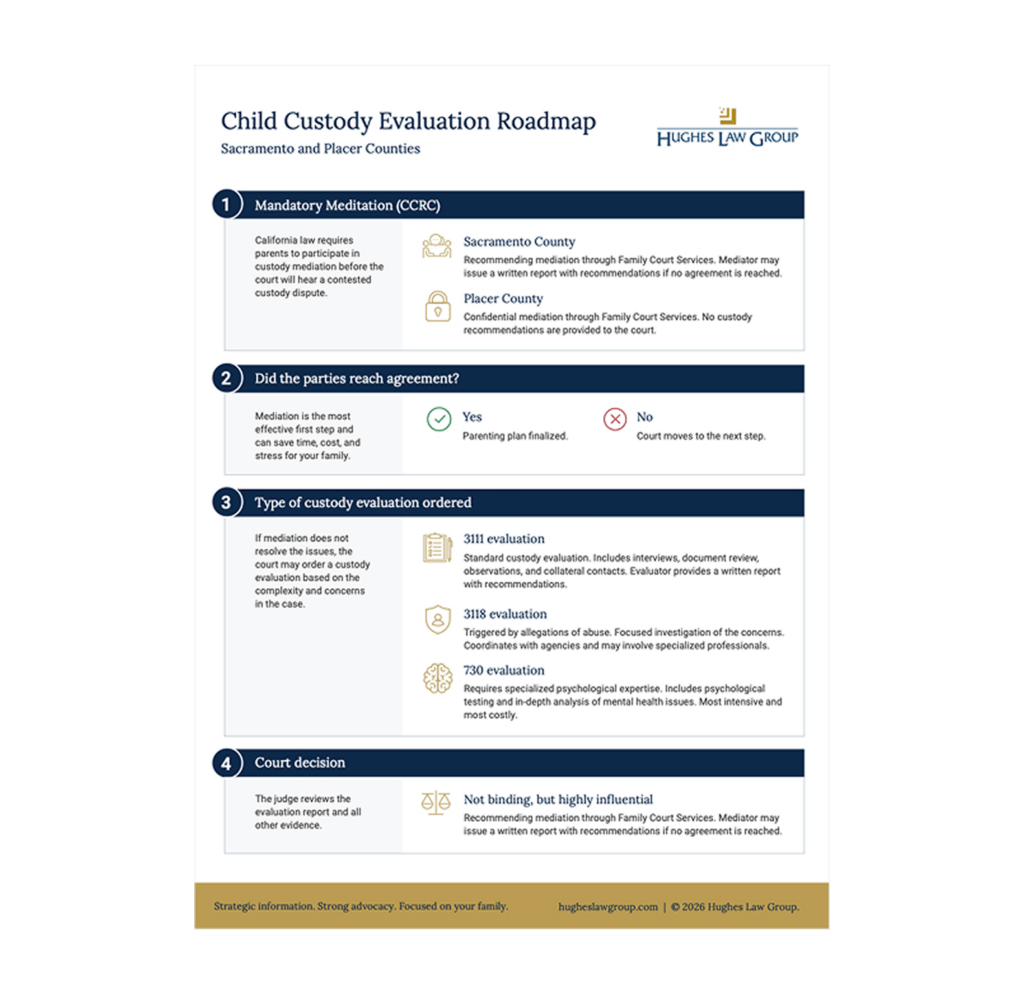
Download Our Visual Guide
Get a quick overview with our downloadable visual guide.
Before any evaluation, you have to try mediation. That’s the law.
California law requires parents to participate in custody mediation with a social worker before the court will hear a contested custody or visitation dispute. The first step is Child Custody Recommending Counseling (CCRC) or mediation. Family Code sections 3170 and 3171 direct the court to set mediation before or concurrent with any custody hearing. Courts have made clear that failure to complete mediation can bar a custody matter from proceeding at all.
If you refuse to participate, you may be procedurally prevented from pursuing custody orders. That is not a bluff. CCRC is not a full evaluation. It is a short, focused process designed to help parents reach agreements quickly with the help of a neutral. The state’s preference is unmistakable: contested custody litigation is time-consuming, expensive, and harmful to children, so the system funnels you toward resolution before it funnels you toward a courtroom. Only when those initial efforts fail does the court move to more formal processes: a further custody evaluation under Family Code § 3111, Evidence Code § 730, or a contested hearing.
How CCRC works in Sacramento County
Sacramento County uses a recommending mediation model at Family Court Services. Local Rule 5.17 provides that mediation is generally non-confidential. If the parties don’t reach an agreement, the mediator prepares a written report with recommendations, which is provided to the court and may be introduced into evidence at a hearing or trial, subject to objection.
This matters strategically. In Sacramento, the court gets an early, structured assessment of your case before you ever set foot in front of the judge for a contested hearing. Judges frequently rely on those recommendations when issuing temporary orders or narrowing the issues before a formal evaluation becomes necessary. What you say in CCRC, and how you say it, can shape your case for months.
Sacramento County also permits parties to choose private child custody recommending counseling instead of court-connected mediation. Local Rule 5.18 sets out the procedure. You’ll need to file a Petition for Private Child Custody Recommending Counseling using local form FL/E-LP-601, along with a proposed order, declarations regarding the mediator’s qualifications, and proof of personal service. The opposing party has ten days to file a response or objection.
Unless the parties agree otherwise, the requesting party advances the cost, and the court later determines how those fees will be allocated. Once private mediation is approved, it replaces Family Court Services mediation. Private CCRC typically allows for a more thorough process and can produce more detailed recommendations tailored to the specific issues in the case.
Placer County does it differently, and it changes your strategy
Placer County does not use a recommending model for initial mediation. Family Court Services in Roseville begins (Tier One) with a confidential mediation session aimed solely at helping the parties reach resolution. If necessary, the process may move to a second stage focused on fact gathering. Even then, the court generally receives only an informational report. Placer County FCS mediators no longer provide custody recommendations to the judge.
That single procedural difference reshapes how you approach a custody case across the county line. In Sacramento, the recommendations are baked into the process. In Placer, the court does not get evaluative recommendations unless the parties affirmatively seek them through a private provider. That means if you want the judge to have a structured analysis going into your hearing, you have to ask for it, and pay for it, yourself. Placer County Local Rule 30.1.1 governs private recommending counseling. You’ll file a Petition for Private Child Custody Recommending Counseling using local form PL-FCS008, along with a proposed order, declarations addressing the counselor’s qualifications, and proof of personal service. The opposing party has ten days to respond or object. As elsewhere, the requesting party typically advances the cost, subject to later allocation by the court. Once approved, private recommending counseling replaces the standard Family Court Services process.
When private CCRC is the right call
Both counties allow private child custody recommending counseling, and the local rules require specific filings, qualification disclosures, and service before the court approves a private mediator.
Private CCRC almost always offers more time, more detailed analysis, and greater flexibility than what Family Court Services can provide on its volume. It also costs more, though the court can re-allocate those costs between the parties later. When time permits and finances allow, private CCRC is almost always preferred. In Placer County, where FCS does not make recommendations to the judge, it is often the only realistic way to get a written, evaluative analysis in front of the court before trial.
If CCRC doesn’t resolve the case, here’s what comes next
When mediation can’t get the parents to agreement, or when the issues are too serious for a short mediation session to handle, the court may order a more formal evaluation. There are three main types, and the one you get depends on what’s at issue in your case.
Family Code § 3111 evaluation: the standard
A § 3111 evaluation is the most commonly ordered formal custody evaluation. It is a court-ordered investigation conducted by a neutral professional.
The evaluator gathers data through interviews, document review, and observation. That typically includes school records, medical records, and prior court filings. The evaluator meets with each parent and the children, sometimes conducts home visits, and may consult collateral sources: teachers, therapists, doctors, or law enforcement if relevant. The process results in a written report with findings and, in most cases, recommendations on custody and visitation.
The standards that govern a § 3111 evaluator are detailed. California Rules of Court, rule 5.220 requires the evaluator to maintain objectivity, actively control for bias, focus on the child’s health, safety, and welfare, and assess each parent in a comparable manner. The methodology has to be structured and the conclusions substantiated through multiple sources whenever possible, not a single account.
The final report must explain how the evaluation was conducted, identify all sources, summarize the time spent and data gathered, and disclose any limitations (such as unavailable records or a party’s failure to participate). Importantly, the report must include relevant information even if it does not support the evaluator’s conclusions. That requirement matters: it gives you a framework for meaningful cross-examination if you challenge the findings.
How much weight does a § 3111 report carry? A lot. Judges typically give substantial weight to a § 3111 evaluation because it is neutral, court-ordered, and conducted under structured rules. The court is not bound by the recommendations, but the report often becomes the central evidence in the case. Settlement positions shift around it. Trial strategy gets built around it. If you have a § 3111 evaluation coming, treat it like the most important meeting of your case, because it is.
Family Code § 3118 evaluation: when there are sexual abuse allegations
A § 3118 evaluation arises when there are serious allegations of child sexual abuse. The court orders this kind of evaluation to ensure a focused and thorough investigation.
The evaluator must analyze the allegations in detail and may coordinate with child welfare services or law enforcement. The 3118 is narrower in subject matter than a § 3111 but deeper in analysis. It focuses on safety and the credibility of the allegations. The resulting report must address the allegations directly and explain how they affect the child’s best interests.
Evidence Code § 730 evaluation: when psychological issues drive the case
A § 730 evaluation is ordered when the court determines that issues in the case require expertise beyond a standard custody investigation: significant mental health concerns, questions about psychological functioning, or the need for formal psychological testing that a § 3111 evaluator is not equipped to perform.
The court appoints a qualified expert with the licensing and training to administer, score, and interpret psychological assessments. The scope is defined by the court’s order, and the evaluator must work within that scope while addressing the child’s best interests.
Why are 730 evaluations so long and so expensive? Because they’re more comprehensive than a standard custody evaluation. They include formal psychological testing, extended interviews, and deeper analysis of each parent’s mental health, personality structure, and parenting capacity. The evaluator may review extensive records and consult with other professionals. These evaluations typically take several months and cost significantly more. Courts reserve them for cases where the issues cannot be resolved through mediation or a 3111: allegations of serious mental illness, personality disorders, or competing expert opinions on the parents’ psychological functioning.
Full versus partial evaluations, and why scope matters
California Rules of Court distinguish between full and partial evaluations. A full evaluation is comprehensive and addresses all custody issues. A partial evaluation limits the scope to specific questions identified by the court.
Scope directly affects cost, timeline, and strategy. A narrowly tailored evaluation can resolve a specific dispute without expanding the case unnecessarily. We frequently advocate for a defined scope to control costs and keep the focus where it belongs, particularly in cases where one or two discrete issues are driving the disagreement rather than a wholesale dispute over parenting.
What actually happens during the evaluation
The process typically includes the evaluator reviewing prior court filings, school records, medical records, and, when appropriate, police reports. The evaluator interviews each parent, sometimes separately, sometimes together, to assess parenting capacity, involvement in the child’s life, and the ability to meet the child’s developmental needs. The evaluator also observes parent-child interactions unless doing so would be contrary to the child’s best interests.
Evaluators may gather collateral information from third parties: teachers, therapists, extended family members, or other professionals with direct knowledge of the child’s environment. When issues fall outside the evaluator’s expertise, the rules allow consultation with other qualified professionals.
How children are involved. Evaluators must use age-appropriate methods when speaking with children. They must explain the process and avoid placing pressure on the child to express a preference. Whatever you may want your child to say, it is not your job to coach them. Evaluators are trained to spot it, and it backfires.
The limits of confidentiality. Custody evaluations are not fully confidential. Reports are shared with the parties and the court. Specific forms must accompany the report explaining the confidentiality limitations and restrictions on disclosure.
What you should do during the process
A few things matter more than people expect:
Be on time and prepared for every appointment. Evaluators notice. So do judges.
Bring documents the evaluator asks for, and bring them organized. A binder with the court order, the prior parenting plan, school records, and medical records, labeled and tabbed, communicates that you take this seriously and that you can be relied on to provide accurate information about your child.
Be honest about your weaknesses. Every parent has them. An evaluator who hears you take ownership of a difficult patch, and explain what you’ve changed, is far more useful to you than one who has to flag inconsistencies later.
Do not coach your children. It is the single most common mistake. Evaluators are trained to detect it, and when they do, the report shifts hard in the other direction.
Do not use the evaluator as a venue to attack your co-parent. State your concerns clearly, factually, with examples and dates if you have them, then stop. The evaluator is not your audience for grievance; they are a fact-finder, and your credibility is the asset you cannot afford to spend.Talk to your attorney before every interview. What you say in an evaluation is going to end up in front of the judge. Walking in unprepared is a strategic mistake even when you have nothing to hide.
FAQ: Child Custody Evaluations in Sacramento and Placer County
If you’re heading into CCRC or an evaluation, here’s what to do next
In both Sacramento and Placer Counties, the court will send you to CCRC or mandatory mediation before it considers any formal evaluation. Mediation is the preferred, most efficient path forward, and experienced counsel will guide you toward realistic, good-faith settlement options. When those efforts fall short, the court may order a custody evaluation that ranges from a narrow inquiry to a comprehensive psychological investigation, and the report that comes out of it will, in most cases, drive what the judge does next.
The level of evaluation depends on the complexity of your case. A clear understanding of the options, plus a clear plan for the process, lets you make informed decisions and avoid unnecessary expense and delay.
If you have a CCRC appointment at Sacramento Family Court Services or Placer FCS in Roseville, a 3111 or 730 evaluation order in your file, or a sexual abuse allegation in your case that may trigger a 3118, bring the following to a consultation: the court order, your most recent parenting plan or stipulation, a written timeline of custodial time over the last six months, and any documents the evaluator has already requested.Serving clients exclusively in Sacramento and Placer Counties, Hughes Law Group offers focused, local expertise on custody evaluations and the procedures that surround them. Schedule a Consultation to discuss your case and protect your parental rights.